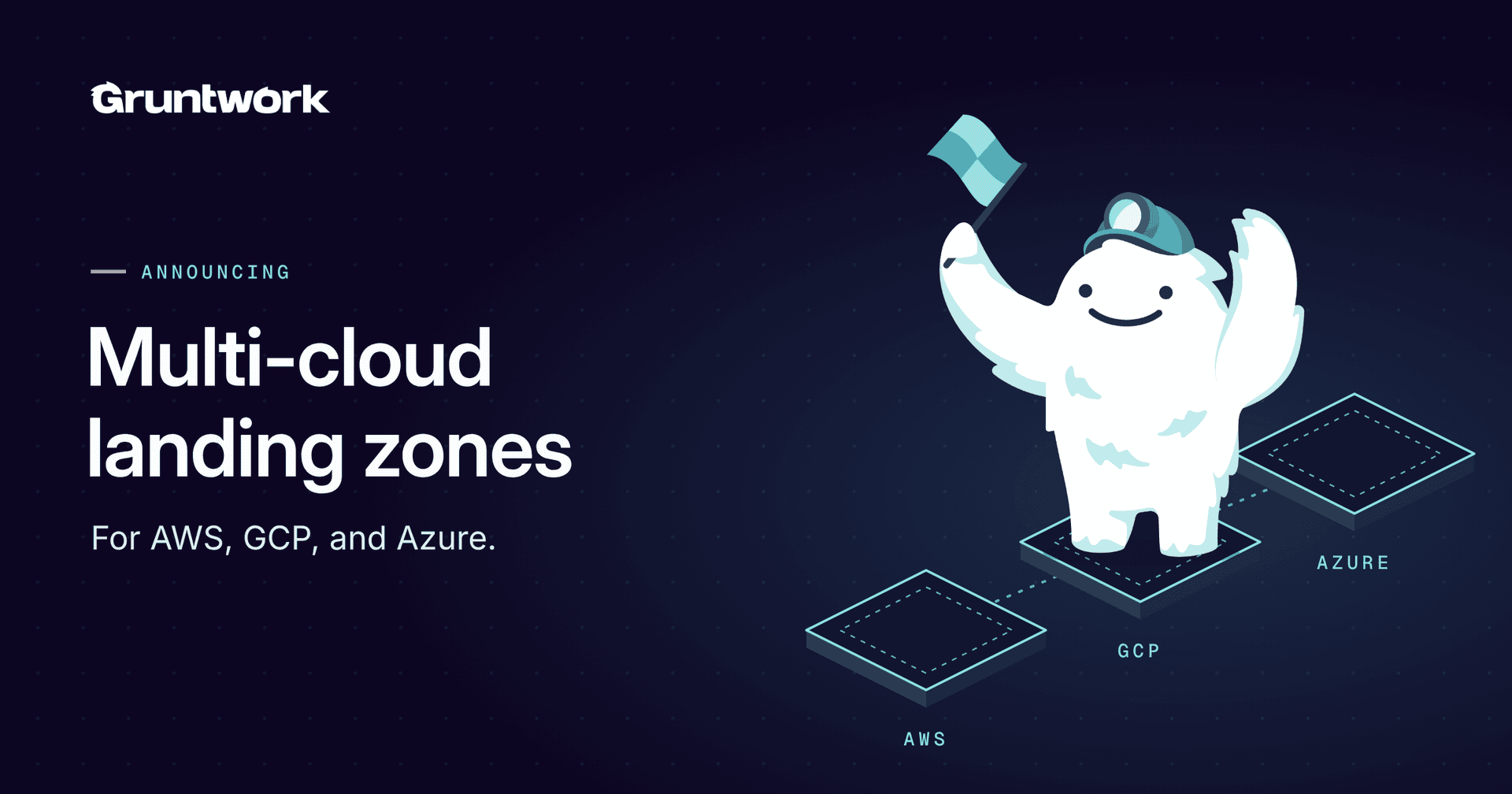
Today, Gruntwork announced the general availability of Landing Zones for AWS, GCP, and Azure: one landing zone foundation across the three major clouds that’s built on OpenTofu and Terraform with a consistent workflow, configuration, and lifecycle operations for every cloud. With this release, one code repository can manage infrastructure across all three clouds, enabling common dependencies, governance rules, and policies to work consistently regardless of where they run.
This post covers: what's new, why we built multi-cloud landing zones, key features, pointers to details, and how to get started.
What is a Multi-Cloud Landing Zone?
Gruntwork’s Multi-Cloud Landing Zones for AWS, GCP, and Azure provide a single, opinionated cloud foundation (accounts, identity, networking, guardrails, and CI/CD) that deploys and manages infrastructure the same way on every supported cloud. A shared foundation means platform teams can manage their various clouds consistently with all infrastructure code unified within the same code repository. Teams get a consistent configuration surface across their previously inconsistent underlying cloud infrastructure.
With Gruntwork’s Multi-Cloud Landing Zones, the configuration surface, gitops-driven lifecycle operations, infrastructure organization, and authentication mechanisms are all identical across clouds. Cloud-specific functionality is still accessible for your application workloads.
Every supported cloud gets the same foundation:
- Everything as code: the entire landing zone lives in version-controlled OpenTofu/Terraform, and every change goes through a pull request.
- Code-driven vending: new AWS accounts, GCP projects, or Azure subscriptions are created through a pull request.
- CI/CD built for infrastructure: plan runs on the pull request and apply runs on merge.
- Automated drift detection: scheduled checks open a pull or merge request when deployed infrastructure no longer matches the code.
- Consistent tagging: one tag and label schema for FinOps cost attribution across clouds.
- Security and governance: guardrails are applied consistently on each cloud.
- Consistent and powerful UX: organize, reuse, and orchestrate infrastructure across every cloud the same way with less code.
What problems do Gruntwork’s Multi-Cloud Landing Zones solve?
Until now, cloud landing zones were built as separate, cloud-specific entities. That often creates incompatibilities between stacks running on AWS, GCP, and Azure. As teams work in different repos to manage clouds with bespoke implementations, differences begin to emerge: different pipelines, review processes, runbooks, etc. and those separate cloud foundations start to slowly drift apart. The separation makes enforcing critical business rules consistently, such as compliance or FinOps cost controls, a logistical nightmare.
Gruntwork’s Multi-Cloud Landing Zones solve that problem. Platform teams can now define their infrastructure once using a unified workflow and interface, regardless of the target cloud. You get one common interface, one configuration surface, one place to define policies, governance and financial controls, and one secure, compliant foundation. No matter which cloud you start with, it’s simple to add the next.
How are Gruntwork’s Multi-Cloud Landing Zones for AWS, GCP, and Azure different from other multi-cloud solutions?
“Multi-cloud” simply means using several cloud providers at once. However, other solutions often force you to manage each cloud separately or give up unique native features to achieve multi-cloud control. In contrast, our Multi-cloud Landing Zones provide a single, cloud-aware foundation. They use a unified landing zone with a common interface across AWS, GCP, and Azure while keeping the full native functionality of each platform.
Ever since there was more than one cloud to choose from, the dream of multi-cloud has fundamentally broken down at the management layer. Most attempts to deliver it make the management layer between your team and the clouds generic so that everything looks the same. Anyone who has tried to build an enterprise product on this “generic” interface knows that eventually you get stuck and have to work around the abstraction to use the features you really need.
Gruntwork Multi-Cloud Landing Zones take the opposite approach. The consistency lives in the interface: common libraries, gitops pipelines, and account vending lifecycles built to operate across all three major clouds. Underneath, each cloud is built the way that provider intends. Each uses the provider's own identity and networking services. Your team operations and business requirements can work consistently across the previously inconsistent underlying clouds.
Why does consistency matter for landing zones across clouds?
When teams spend time managing inconsistencies and drift between cloud implementations, that operational drag becomes critical when business needs unexpectedly change. By using the same landing zone foundations across multiple clouds, teams can gracefully unify management of their entire cloud estate with a consistent infrastructure as code workflow. When teams need to develop new landing zones, nothing else changes and adding new clouds or infrastructure components becomes simple and fast.
Events that can force you to develop a new landing zone include absorbing accounts from an acquisition, standing up a new region for a customer, or onboarding a new business unit. Each of those means another round of setting up account structure, identity, networking, guardrails, and pipelines. Using a second cloud means doing all of it again, but in a different dialect.
Using one common interface across all clouds means building in the right patterns from the start. That enables you to skip months of delays when doing things like:
- Migrating from cloud to cloud
- Migrating from on-prem to cloud
- Scaling up your existing infrastructure
- Adapting to meet new customer regionality or security requirements
- Launching a new product
- Ensuring consistent compliance and data sovereignty standards
- Infrastructure modernization (consolidation, standardization, Internal Developer Platforms, etc)
Why is Gruntwork delivering Multi-Cloud Landing Zones for AWS, GCP, and Azure now?
In our customer base, we see more infrastructure teams implementing multi-cloud solutions or starting to consider them, the three main factors that keep surfacing are:
- AI workloads that run wherever the best models and capacity are (which is often not the cloud a team started on)
- Cost leverage, and avoiding lock-in to any one provider
- Regionalization, driven by data sovereignty rules and customer contracts
We see these pressures repeatedly pushing more teams toward adopting another cloud. The best and cheapest time to standardize is before the second cloud shows up. Using landing zone foundations built to work across different clouds means your team can quickly adapt to any business need because work is already happening consistently and absorbing change is no longer disruptive. Cloud infrastructure shouldn't be so hard, and extending your business across clouds shouldn't be either.
How can you learn more about multi-cloud landing zones?
For the design decisions, core components, setup steps, and common anti-patterns behind a production landing zone, start with our various guides:
- The AWS Landing Zone Guide
- The GCP Landing Zone Guide
- The Azure Landing Zone Guide (in development)
Talk to us about your landing zone
If you lead a platform team and are considering how to manage deployments across clouds, book a multi-cloud assessment with our team. We'll walk through your current cloud footprint, and how to move to a single foundation.



-
No-nonsense DevOps insights
- Expert guidance
-
Latest trends on IaC, automation, and DevOps
-
Real-world best practices