Many cloud environments start by configuring resources through the provider’s console. This works for the initial product launch, as it allows teams to move fast and experiment early on. Then, as the environments, infrastructure needs, and teams grow, it starts becoming difficult to manage, govern, and scale changes.
This is the point where many teams start looking at infrastructure as code (IaC). IaC has become the gold standard for managing cloud infrastructure and a core principle of a robust platform engineering strategy.
This article covers three questions: When does it make sense to move from ClickOps to IaC? What does IaC give you that the console does not? And if you are already deep into ClickOps, how do you migrate without stopping your running systems and rebuilding from scratch?
The examples on this blog use AWS/Terraform/OpenTofu, but the principles are general.
What is ClickOps?
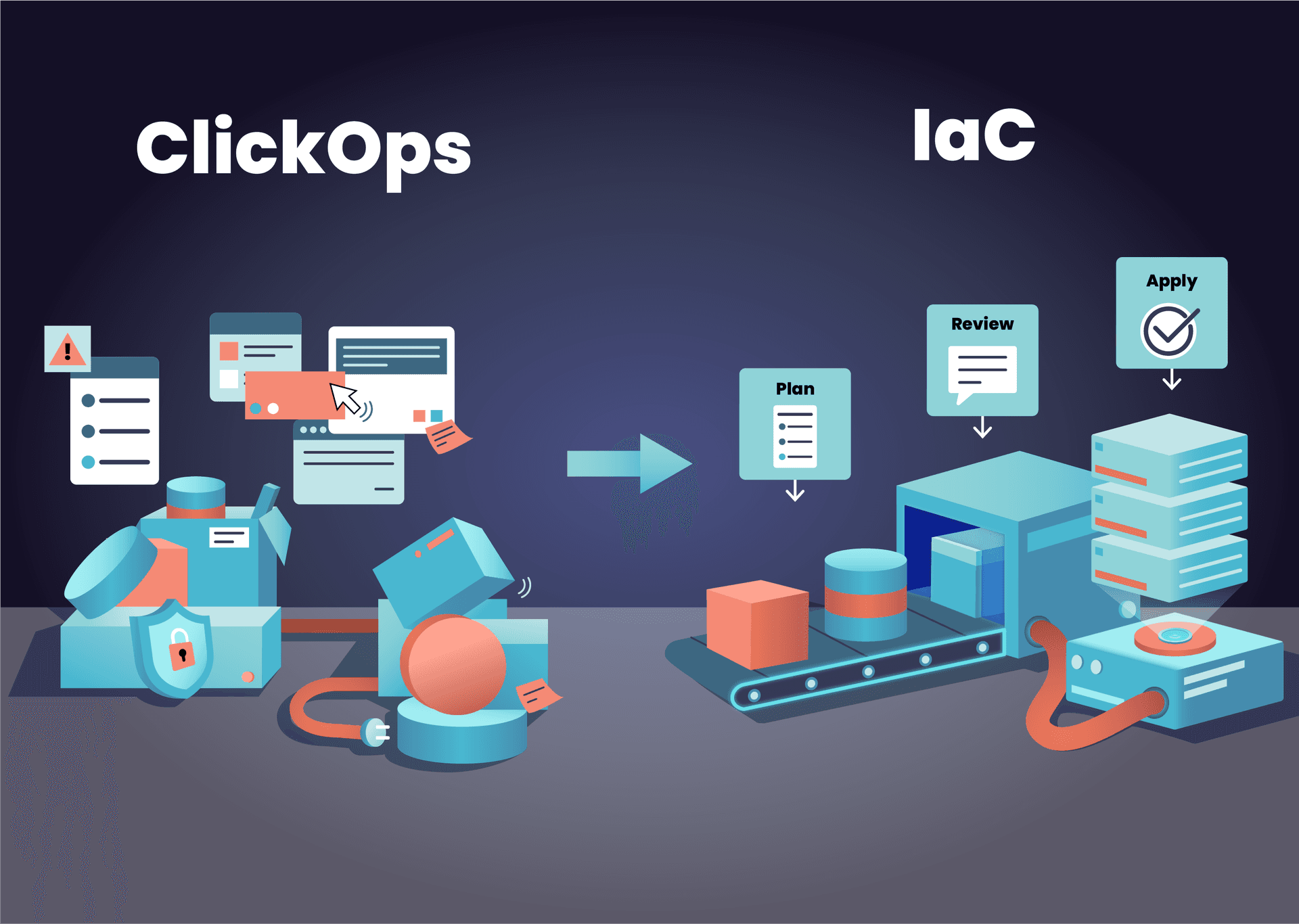
ClickOps is the practice of building and changing infrastructure by hand through a cloud provider's web console. You open the AWS, Azure, or Google Cloud dashboard and click through to create and configure what you need via a series of manual steps. It’s the path of least resistance to begin with because it requires no upfront investment in learning a new tool or defining standards, pipelines, guardrails, and processes.
Feedback is also immediate, allowing you to iterate and experiment really quickly. For a prototype, testing, or experimenting with an unfamiliar service, this is a common choice. Apart from such cases, though, ClickOps usually becomes a burden over time due to the nature of manual changes and the non-determinism it adds.
Where ClickOps breaks down
ClickOps relies on manual changes that cannot be easily reproduced, and there is no easy way to inspect and reason about the state of your resources and environments.
Replication is slow and unreliable: Replicating environments for new customers, projects, or regional expansion with ClickOps means repeating changes manually. The process is slow, error-prone, and can result in inconsistencies between setups.
No review or collaboration: A console change takes effect the moment you click and there is no second pair of eyes, no approval step, and no shared place to discuss a change before it reaches production. As more people gain access, collaboration and validation of ongoing work become increasingly difficult with ClickOps.
Environments drift apart: Different environments, such as development, staging, and production, are supposed to match, so that a test in one predicts behavior in the other. When both are built by hand at different times, they often tend to diverge, introducing unpredictability in testing. There is no defined desired state to compare against, so there is no easy way to spot when environments have drifted.
No automated recovery: In cases where you need to recover from a failure or roll back to a previous state, the ClickOps approach, which relies on outdated documentation or people’s knowledge, is cumbersome, slow, and error-prone. In such cases, recovering quickly and safely can be critical to resuming business operations.
Even though many teams start there, most eventually outgrow ClickOps. The real question is when it’s the right time to move to a robust IaC setup.
When should you move to IaC?
There is no single metric, such as resource count or company size, that marks this moment. The better way to read it is by signals. A few indicators:
- If your team is running multiple environments that need to stay in sync, but this is becoming increasingly challenging.
- Multiple people have write access to the cloud console.
- Difficulty in keeping docs up to date with processes on how to create and change infrastructure manually.
- Compliance audit needs. Frameworks such as SOC 2, ISO 27001, HIPAA, and similar expect you to be able to show who changed what and when. That evidence is straightforward to produce from version control and IaC.
- Multiple incidents related to manual changes and workflow errors.
- Standing up new environments or infrastructure resources takes considerable effort and time.
Try answering this question honestly: How long would it take your team to rebuild production from nothing today, if you had to? If the honest answer is days or more, that is a strong enough signal.
ClickOps still has a place. For a solo experiment, a throwaway sandbox, or exploring a service you have never used, the console is fine and often faster. Keep the console for what it is good at and ensure that anything worth keeping long-term is defined in code.
Benefits of IaC over ClickOps
Moving to IaC turns infrastructure from a series of manual actions into a codebase you can version and reuse:
Version control and audit trail: With version-controlled IaC, you get a full history of changes, with the reasoning captured in commit messages and pull requests. IaC declares what the infrastructure should look like. That also provides a verifiable audit trail, drift detection, and rollback and disaster recovery capabilities in case of issues.
Repeatable environments: Since the infrastructure state is defined in code, producing a new, similar environment is quick and easy. Spinning up a new region, a new account, or an identical staging copy is as simple as running some code. Environments built this way match each other, which is what makes testing trustworthy again.
Review and automate checks before changes land: Because changes are code, they can go through pull requests, peer review, and automated testing before they touch production. Policy checks, security scanners, and linters run in the pipeline, catching problems early. Even more, new engineers can read the codebase to understand how the infrastructure fits together and get up to speed.
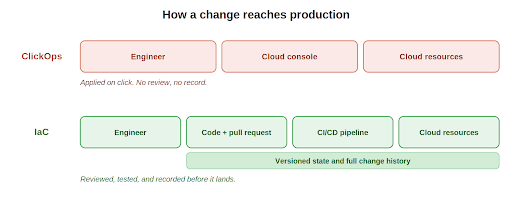
Although these benefits are well understood, many organizations still operate in a partial state, with some infrastructure in code and much still managed by hand.
How to migrate from ClickOps to IaC
Adopting an IaC-first approach and migrating existing brownfield projects is a task that shouldn’t be underestimated. The approach that we have seen working best in practice is incremental adoption and migration. You move in batches, keep the business running, and show results at each step.
Here’s a practical step by step guide:
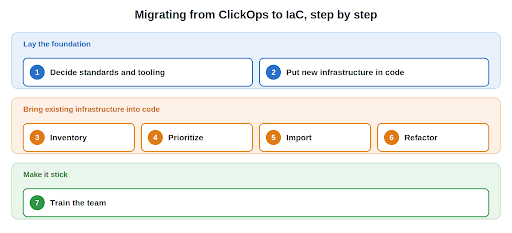
1. Decide on standards and tooling first: Which IaC tool will you use? Terraform and OpenTofu are the common choices, with OpenTofu offering an open-source path under the Linux Foundation. Spend time thinking about the repository's structure, conventions, naming, tagging, and organizing code in modules. If you are looking for inspiration, check out our Terraform Style Guide, our recommended folder structure, labels and tags, and the comprehensive Terragrunt infrastructure catalog examples.
Set up a remote state with locking and an automated deployment workflow early, so the foundation is in place before you build on it.
2. All new infrastructure in code: After you have the foundation in place, any new infrastructure must go through the IaC flow; nothing new gets created in the console. Move all changes through Git and CI/CD, and restrict console write access for the new resources (define break-glass scenarios and console experimentation processes). Add drift detection runs to catch any changes that slip through.
3. Inventory what already exists: Then, you have to start thinking about your existing resources: First step is to discover and map what you already have. Different tools can help you with this. On AWS, the AWS Config service can help you automatically inventory AWS resources across multiple accounts and regions. Other approaches are checking the AWS Resource Explorer for simpler and smaller setups, or scripting a scan of resources with the granularity that you want, based on the AWS CLI.
4. Prioritize: Start with the resources that change often or carry risk. Stable legacy pieces can wait and, in some cases, stay as they are (e.g. if there is a timeline to decommission them).
5. Import existing infrastructure: Here is where the actual migration starts. OpenTofu and Terraform bring existing resources under management through import. The older approach is the import command, which records a single resource in state but does not write the configuration for you:
terraform import aws_instance.web i-1234567890abcdef0
Tofu/Terraform import blocks let you declare imports in configuration, preview them in a plan, and generate a starting configuration automatically:
import {
  to = aws_instance.web
  id = "i-1234567890abcdef0"
}
Running terraform plan -generate-config-out=generated.tf then writes a first draft of the resource block for you.
Check out the import resources overview and import resources in bulk on how to approach this at scale.
Something to keep in mind: Generated configuration tends to be flat and verbose, and it captures the current state exactly, including whatever was misconfigured. Import gets the resources into the state and into a rough configuration. You might need to iterate and clean up next.
6. Clean up and refactor after importing. Once resources are in code, you have to think about refactoring them in a way that makes sense. Group repeated patterns into reusable modules, and separate environments cleanly. This is how the imported mess turns into a real codebase, and where most of the long-term value comes from.
7. Train the team: Tooling alone does not change habits. It’s important to align on the direction. Invest time and resources in upskilling the team, document the standards and common workflows, and support engineers throughout the journey. The goal is to make the IaC path the easiest one to follow, so the change doesn’t become a burden.
A few pitfalls to watch out for:
- Importing everything at once: Move in small, prioritized batches instead.
- Skipping standards and state design: Decisions about standards, conventions, rules, state management, and code organization are hard to undo if you leave them as an afterthought.
- Leaving console write access open: Good intentions don’t work; systems and well-defined processes do.
- Treating generated code as the end state. Imported configuration is only a starting point. Without refactoring into modules and clean environments, you end up with a messy codebase.
How Gruntwork helps teams move off ClickOps
Importing existing resources is a well-documented process. The harder part comes next: How do you organize your IaC and your workflows so the result is consistent, efficient, and compliant? This is the gap Gruntwork is built to close.
A library of production-ready modules: The Gruntwork IaC Library provides more than 300 maintained Terraform and OpenTofu modules for AWS, covering foundations, applications, and data services. This library allows you to base your setup on proven patterns that have been tested and aligned with benchmarks such as the CIS AWS Foundations Benchmark.
Pull-request-driven deployment and drift detection: Gruntwork Pipelines runs infrastructure changes via pull-request-based CI/CD, ensuring every change is reviewed and applied through a single, consistent workflow. For importing existing resources, you can author import blocks and drop them into your infrastructure live repo. This brings the import process into IaC and makes it repeatable and auditable. Drift Detection flags resources that have changed outside of code, allowing you to detect deviations from the source of truth, like old console habits.
Standardized account provisioning: Account Factory provisions new cloud accounts via GitOps, each with built-in security and compliance baselines.
Configuration that scales with Terragrunt and Stacks: Terragrunt, the open source IaC orchestrator, can help keep your IaC codebase manageable and reduce repetition. Stacks group related units into versioned entities, so you can manage infrastructure at scale while keeping the blast radius of any change small.
Keep IaC up to date with Patcher: Infrastructure code is an ongoing project. Patcher identifies outdated modules and opens pull requests to update them, keeping the codebase current and reducing the operational maintenance burden.
For teams that want hands-on help rather than tooling alone, Gruntwork's IaC Residency pairs expert engineers with your infrastructure team to design, refactor, and operationalize your setup. It is aimed at teams moving to IaC or outgrowing an early architecture, with a focus on leaving your team with the patterns and confidence to maintain the result.
For a concrete example, a large healthtech organization leveraged Gruntwork to move from ClickOps to IaC in six months. The organization relied on console-driven AWS changes, with environment drift and tests that did not reflect production. Pursuing HITRUST certification for B2B growth gave them the push to modernize. By adopting Gruntwork’s solutions, they delivered consistent environments and achieved developer empowerment, efficiency gains, and compliance readiness.
Conclusion
ClickOps is a reasonable place to start for many organizations. It gets a product running quickly and requires no upfront investment. For early-stage work or experimentation, it remains a fine choice. The problems start appearing when things need to scale with signals such as incidents, inconsistent environments, difficult to follow manual processes, and audit needs that are difficult to fulfill.
When those signals show up, IaC is the answer. Version control, repeatable environments, reviewable changes, and testable recovery give you the controls you need to scale your infrastructure safely. Once you start on this journey, migrate incrementally, add all new resources to the code, inventory what you have, and import the rest in order of priority. Decide on your standards before you import, and refactor the generated code into something maintainable afterward.
Gruntwork can help you get there quickly and safely. Book your demo today!



-
No-nonsense DevOps insights
- Expert guidance
-
Latest trends on IaC, automation, and DevOps
-
Real-world best practices